The Brief
Start by doing some of your own research into the photographers discussed. Then, using fast shutter speeds, try to isolate a frozen moment of time in a moving subject. Depending on the available light you may have to select a high ISO to avoid visible blur in the photograph. Add a selection of shots, together with relevant shooting data and a description of process (how you captured the images), to your learning log.
Preparation
For this exercise, I wanted to shoot something that reminded me of the research in the Project ‘The Frozen Moment”. The pioneers who used photography to investigate the physics of the natural world interested me because of my engineering past. The almost accidental beauty of the images they produced offer both that instant slice of time, but also a close and personal view of phenomena that had previously been postulated rather than observed. For my Freeze shot, I wanted to do something similar.
My idea
To capture the falling grains of sand in an hourglass and suspend them in time. This idea came to me when thinking about the time element to the work in the project. Hourglasses are a classical tool for measuring time, dating back to 350 BC in ancient Rome and are still used today for fairly mundane tasks such as boiling an egg for the correct duration. The grains inside an hourglass fall in a column under the influence of gravity and move rapidly, so to freeze their motion with a fast shutter speed would be a good example of what Szarkowski was talking about [1].
The setup
My first plan was to shoot the hourglass closeup with a continuous LED light source and fast shutter speed. I selected my 200mm f/4 macro lens which is capable of focusing down to 50cm and a Manfrotto LED. This lamp provides an even beam of light at 3 different power levels and I’ve used it many times to illuminate small areas. My abstract images in Exercise 1.3 used this light, with different gels applied. The layout is shown below.

Pretty early on, I realised that there was insufficient light to allow for a high shutter speed (> 1/2000th of second was what I was aiming for). Increasing the ISO obviously started to degrade the image quality and although the Nikon D4 is capable of ISO 204,800 through clever use of it’s electronics, I wanted the images to be usable. So, I turned to the work of AM Worthington, who started using electrical sparks as lighting sources; an idea taken forward by Harold Edgerton. Both men saw that if you strobed the light source, the shutter could be a lot slower, something which they had no real choice of doing in the early days of automatic shutter design. The durations of some of their flashes were as short as 1/1,000,000th second. As long as the flash edge is short, any motion in the subject is frozen, a technique used today by fashion photographers in the studio.
I have used flash sources previously so decided to start with my speedlight flashgun. I connected the flash to the camera via a cable so that it could positioned relative to the subject instead of mounted in the hot shoe. With flash sources, the common misconception is that the higher the power, the more intense the light. In actual fact, the unit simply extends the duration of the flash to get the intense light coverage. For this shot, I wanted to have the shortest possible flash time, so I set the power to its minimum; 1/128th of its range.
I had purchased an hourglass with black sand grains, which against a white background would give a good level of contrast. For the background, I used a piece of semi-gloss photo paper.
The Photograph
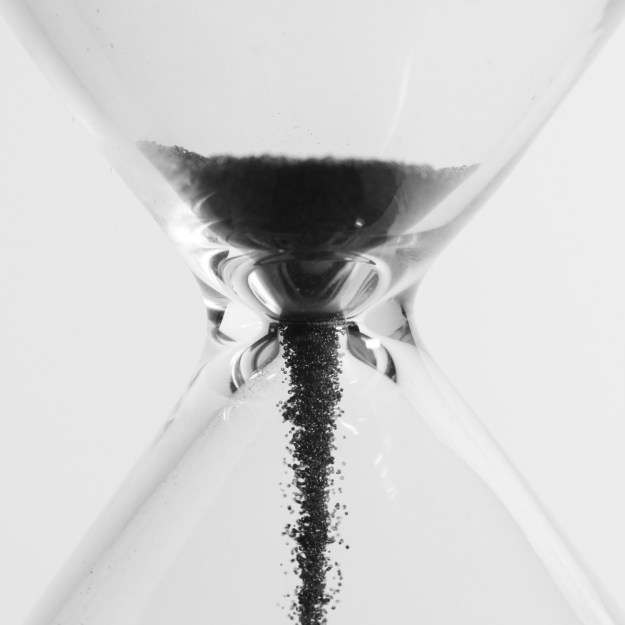
f=200mm at f22, 1/250th second, ISO1600
Reflection
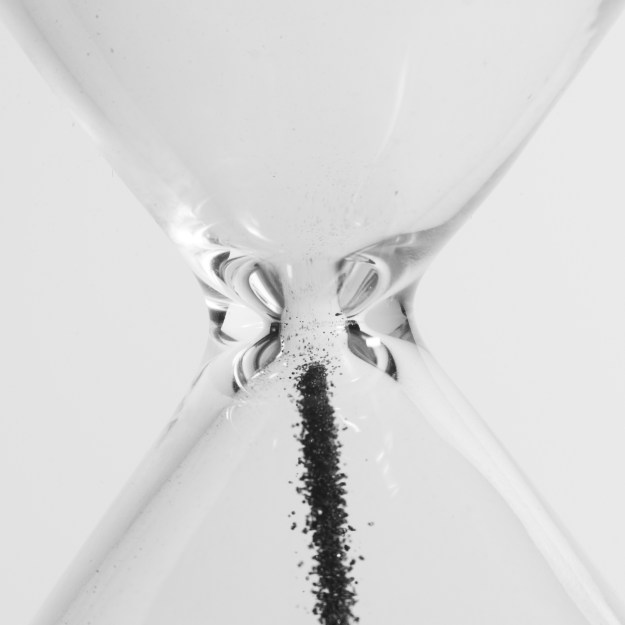
My early attempts with the flash were much better technically than those taken with the LED light source, mainly due to getting a good amount of light on the grains of sand to give contrast to the background. At ISO1600, the noise performance of the D4 is not perceptively degrading the image quality. This left the composition itself. My original intention was to freeze he falling grains as they exit the upper part of the hourglass, effectively creating a column in the lower section. After several attempts to capture the brief moment when that occurs, I had a frame that didn’t really work. The composition above has balance in the upper and lower sections of the hourglass in each corner of the square-cropped frame. I am happy with the simplicity of the composition and the choice of converting to Black & White to remove any colour present in the light fringing within the glass. There was enough light to pick out the grains of sand and a short enough pulse to freeze the movement. What puzzled me for a while was how some of the grains are very sharp and some are not, depending on their position in the ‘column’. Even with a shallow depth of focus, they are more apparently random than I had expected. I then realised, that I was viewing them through a curved glass whose imperfections are most likely to be the cause. The effect of mixing sharpness with softness really works for me, though. From a compositional perspective, it is the presence of the grains in the top section that have yet to fall that makes the hourglass stand out. While the image I was trying to shoot was ‘clever’, it didn’t work as a photograph for me. I’ve included the rejected image below.
The Rejected Image
 Richard Fletcher OCA Photography Blog