This is about seeing and not seeing, about the hole in the wall acting as a round lens letting light into a dark camera interior, about framing of vision, oppositions of dark and light, the curiosity of looking into a dark space, and about the figure caught between two objects that capture her image, the hole – her face – and the camera – her body.’ – Leonard Folgarit
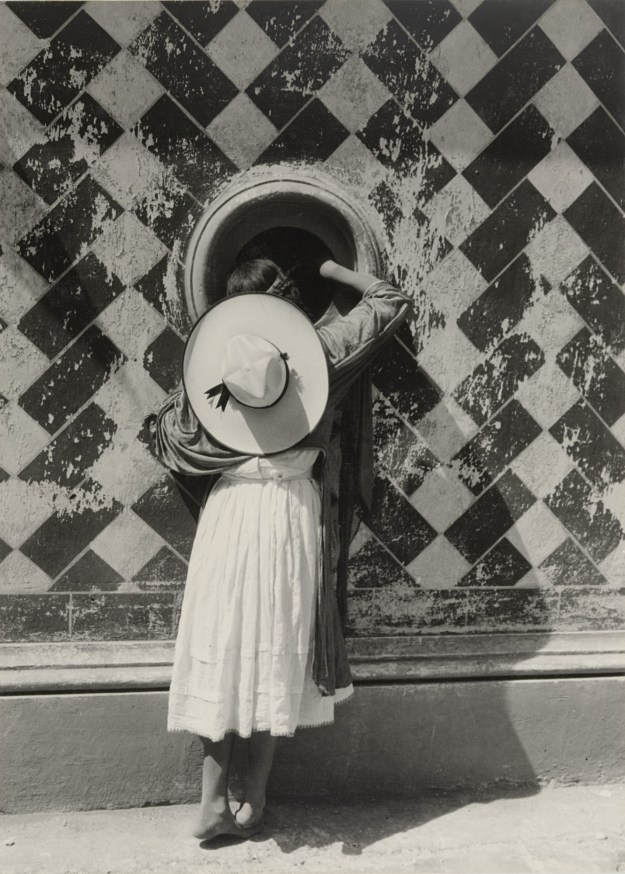
The Daughter of the Dancers, by Manuel Álvarez Bravo, 1933
This was Leonard Folgarit’s review of The Daughter of the Dancers, by Manuel Àlveres Bravo that was quoted at the start of this Project. The concept being established in this section of EYV was of The Aesthetic. According to the Stanford Lexicon, “the term ‘aesthetic’ has come to be used to designate, among other things, a kind of object, a kind of judgment, a kind of attitude, a kind of experience, and a kind of value”. In the context of this course and, more importantly my approach to photography, the concept of a picture having any of these elements to it is a further departure from what I am used to. Sure, I have been told about a photograph telling a story and having meaning, but my reaction has been to carefully place subjects in the frame to create an interesting composition. Any emotion or judgement or value attached to the image would be fortunate at best and accidental at worst.
The review of Thomas Ruff’s work interested me, not because of the visual tension his images created when viewed, but the increased sense of what was happening in the picture, enhanced by having all the technical detail stripped away. My only issue really being that his use of other people’s photographs moved him away from ‘photographer’ in my mind and towards ‘artist’. I was discussing his work with a colleague today, who is also a photographer. When I explained the story of Ruff’s ruined images of the 911 attacks and his subsequent downloading of low-resolution versions of other people’s work, he was horrified. “Can you even do that?”
I got to thinking about the work of modern artists such as Tracey Emin and Damien Hirst. Like all artists who create art from seemingly ordinary objects or collages of images, they are effectively not something they own. Emin’s bed, for example is at face value (Surface) as being simply the creation of any teenager, but when asking questions about how the individual elements came to be there can easily lead to the artist’s narrative. However, many people including myself saw what was in front of them and the judgement of it being a wasteful, almost narcissistic statement by someone with clear issues now appears to be as valid as the emotions Emin was trying to convey about a dark time in her life. Everyone will have a different view. What makes the difference to me is, like The Daughter of the Dancers, the viewer cannot see what is going on beyond the obvious ‘surface’. What is happening deeper in this picture? How did the owner of the bed get both it (and presumably themselves) into such as state?
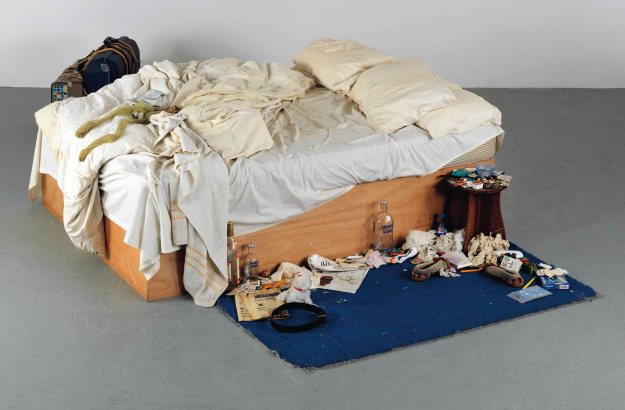
My Bed by Tracey Emin, 1998
Coming back to Ruff’s work, I decided to look at other examples of his work and found a collection he created in the early part of this century called Nudes. Like jpegs, Nudes is a seemingly obvious subject that achieves an aesthetic when a level of distortion is applied. However, in this case Ruff downloaded pornographic images from the internet to make his art. What reaction do these photographs create? For me, initially shock followed by a softer appraisal of what could easily be a classical art nude, with all its potential beauty. But it’s still porn at the heart of it.
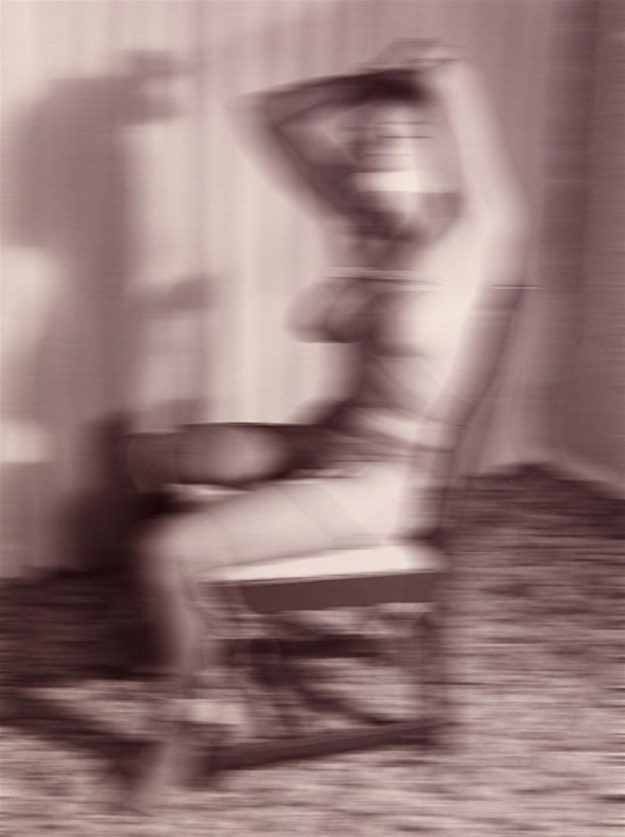
From the collection ‘Nudes’ by Thomas Ruff, 2000
The difference between my predecessors and me is that they believed to have captured reality and I believe to have created a picture. We all lost, bit by bit, the belief in this so-called objective capturing of real reality.
Each of my series has a visual idea behind it, which I develop during my research. Sometimes the development follows a straight line from A to B; sometimes something completely new and interesting shows up, which makes me leave the straight path and follow a more indirect one with new rules.
—Thomas Ruff
Reflection on my Work
With the distinction between the concepts of formal and aesthetic better understood, I reviewed some photographs from a recent test of an old Olympus XA film camera I had picked up on eBay. This was a few rolls just seeing how it performed as an instrument and I was shooting them during a visit to London on holiday. One image in particular stood out as demonstrating both the formal and the aesthetic which can be seen below.

The photograph was made using an expired Kodak Ektachrome slide film, a characteristic of which is a colour shift caused by age. This was simply a test of the camera’s ability to meter the scene (no evaluative metering on a camera from 1979!). The dominant light from a very sunny day and the composition with the subject on the right hand third line was all planned. However, in review there are aesthetic questions that arise. We cannot see what the gentleman is doing. Is he reading a phone while waiting for someone or is this quiet cafe a regular haunt for him? I was hoping for more detail in what was beyond the cafe’s window, but the fact that there isn’t asks what would people see if they looked in at this man? I was surprised to realise that the image, while a simple and seemingly boring test of an old camera and film actually asks more questions than it answers. For me, not dissimilar to my reaction when I saw Bravo’s photograph.
Ever the engineer, I wanted to look at this further with another recent photograph. This time, I had shot a performance of The Ladykillers by a local theatre company for their publicity and personal use. This one photograph illustrates for me the difference between creating an aesthetic and a formal composition.
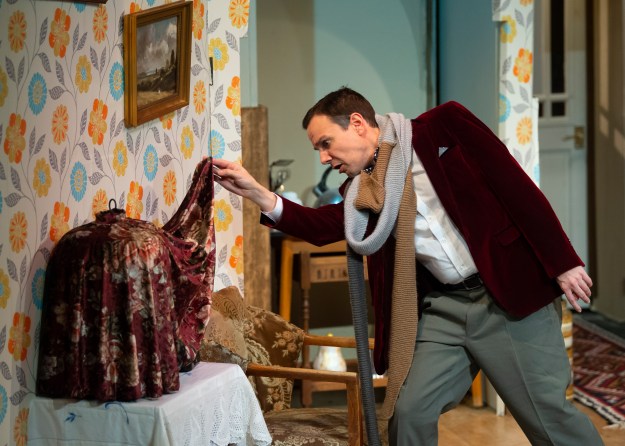
The Ladykillers, 2018
In this scene, the lead character looks under the cover over a bird cage. While his reaction to the horror within is clear, the only aesthetic is not being able to see the bird. From the formal composition, it is clear how the two subjects are interacting and obvious that the cage contains some kind of bird or animal. For me, the photograph works well as a composition but doesn’t provoke any real emotion or judgement.
In conclusion, I found this Project fascinating as it reveals what can be achieved without the necessity to be obvious, technically accurate or abiding by the rules.
 Richard Fletcher OCA Photography Blog